Drink Guides
Hot Canned Soup in Japan: How the Vending Machine Switch Actually Works
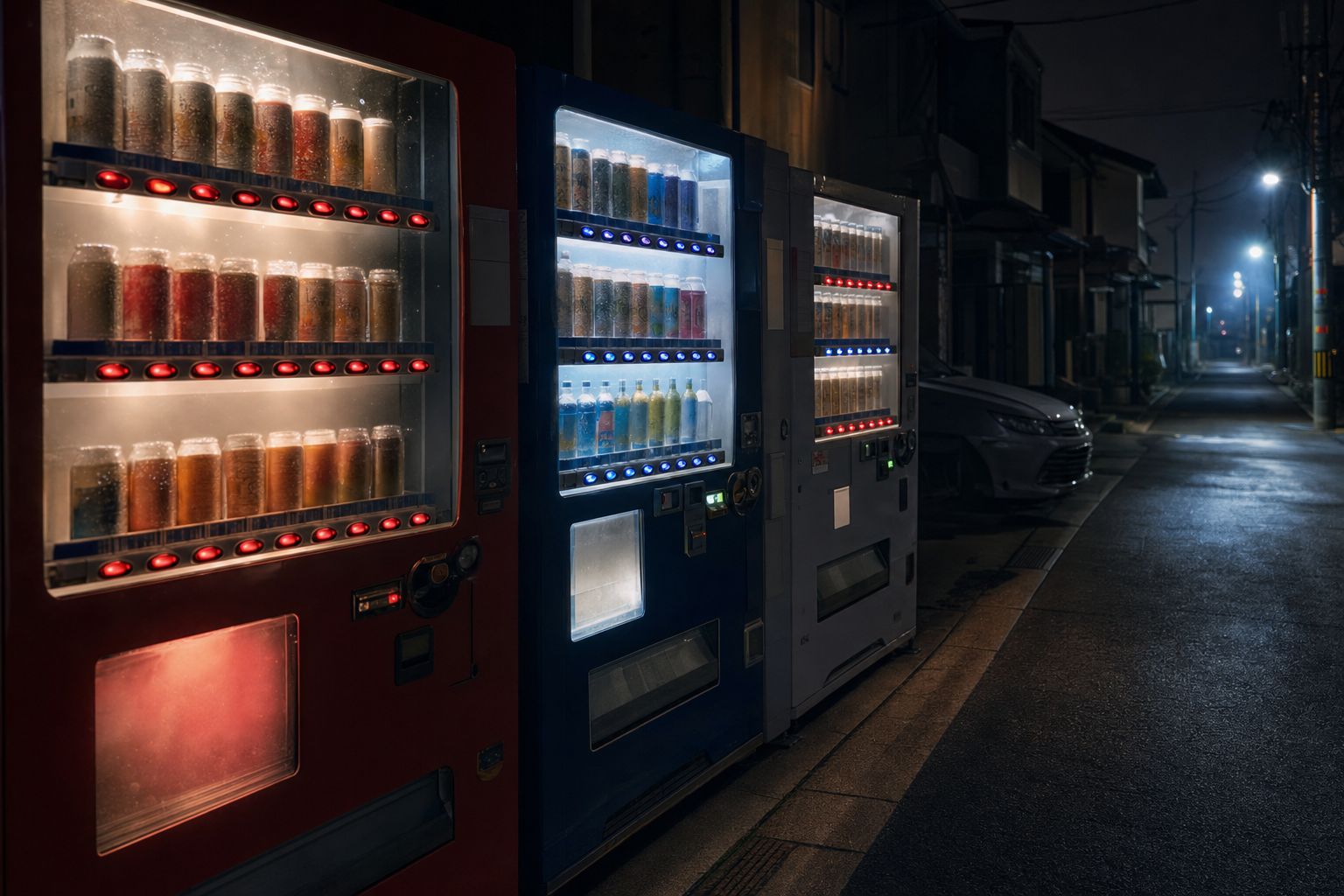
Stand in front of almost any vending machine in Japan from November through February and you’ll notice something that doesn’t really exist back home: half the buttons are glowing red. It’s not a warning light. It’s a temperature. Those machines are selling drinks warm, straight out of the can, for the same price as the cold ones three buttons over. Convenience stores run the same trick a few feet away, in a small heated case next to the chillers.
The short version: Japanese vending machines and konbini drink cases run two temperatures out of one unit — red for hot (atatakai), blue for cold (tsumetai) — and the switchover happens by weather, not by calendar date. One of the stranger things that shows up on the hot side every autumn is canned corn potage, a soup that’s only sold part of the year, and in 2026 it’s getting a flashier refresh for a brand’s 30th anniversary.
The red button and the blue button
Most vending machines in Japan aren’t dedicated hot or cold units. They’re both, stocked side by side in the same box. The tell is the background color behind each drink’s button: a red field marked あたたかい (atatakai, “warm”) on the heated side, a blue field marked つめたい (tsumetai, “cold”) on the chilled side.
It’s a small design detail, and once you’ve noticed it, you can’t stop noticing it.
Convenience stores run a simpler version of the same idea: a small glass-door warmer, usually near the register, holding canned coffee, tea, and in winter, soup. Same price as the cold version, just pulled from a different door.
Why this only really works in Japan
Hot canned drinks aren’t a given everywhere, and that’s less about taste than about hardware. Keeping canned coffee hot inside a vending machine is largely a Japanese invention — industry accounts of the format trace it back to 1973, when a beverage maker worked with vending machine manufacturers to solve the actual hard problem: holding a sealed can at a steady serving temperature for hours while it sat unsold. Once that machinery existed, everything else could ride the same setup — hot tea, hot cocoa, and eventually hot soup.
What actually triggers the switch
Nobody flips every machine in the country on the same day. Beverage companies make the call store by store, machine by machine, and the trigger is the weather. Local news coverage of Kirin Beverage’s seasonal changeover reported that the company starts converting machines once daytime highs drop below 25°C — and in a year with a long, warm autumn, that rollout can run a full week or more behind the usual schedule.
So a machine’s hot lineup builds gradually over several weeks, which is also why the showier cold-weather items — the soup, mostly — don’t show up on day one. They’re added once the lineup is worth the shelf space.
The soup that only exists half the year
Canned corn potage is the one item here that genuinely surprises people the first time they try it: a warm, faintly sweet soup, drunk straight from a can, standing on a street corner. It’s stranger than it looks on the shelf, too. It’s treated as a cold-weather product: it arrives with the hot lineup in autumn and drops out of most machines once spring comes. It isn’t a year-round drink that happens to sell better in winter. For a good part of the year, you simply won’t find it in a machine.
It’s also not the only name in the case anymore.
| Maker | Product | What’s notable about it |
|---|---|---|
| Pokka Sapporo (Jikkuri Kotokoto) | Corn potage, plus a 2026 anniversary lineup | The long-running default — 30 years on shelves |
| DyDo Drinco | Noukou Deli Koku Toro Corn Potage (“thick and rich” corn potage) | Launched in 2018, renewed for fall 2026 with a wide-mouth can |
| acure / Ippudo (JR East, 2022) | Canned tonkotsu ramen soup | Reportedly outsold the standard corn potage by up to 1.5x in its debut season |
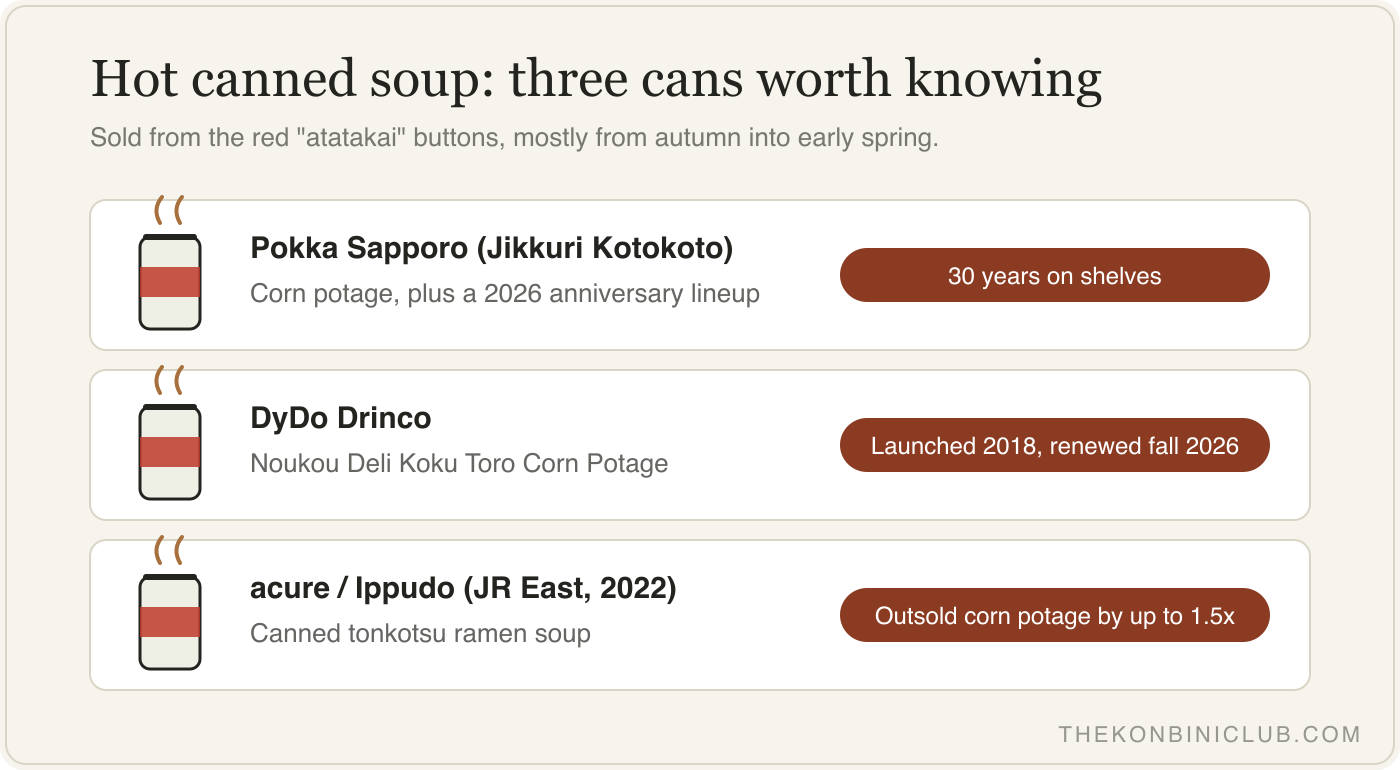
That acure number is the one that sticks with me. When JR East’s station-kiosk vending brand launched a canned Ippudo-branded tonkotsu soup back in October 2022, trade press reported it beat the machine’s standard corn potage by as much as 1.5 times in sales that season. For a category where corn potage has been the automatic choice for about as long as anyone can remember, that’s a real result — proof the shelf isn’t as settled as it looks.
Thirty years of the soup can everyone already knows
If you’ve bought a canned soup from a Japanese vending machine at any point in the last three decades, there’s a decent chance it was a Jikkuri Kotokoto can, from Pokka Sapporo. The brand launched in 1996 and has put out more than 300 varieties since, under a name that translates to something close to “slowly, slowly simmered.” 2026 is its 30th year.
Trade coverage of the anniversary reported five new products — mostly the boxed instant soups the brand is best known for in supermarkets, not cans — rolling out on August 24, 2026: broccoli-and-cheese, sweet potato, chicken cream, corn, and clam.
Corn, notably, still made the cut.
Thirty years and 300-plus flavors is a long run for a product that vanishes from shelves every spring, and it says something about how deeply this specific kind of soup has settled into how Japan thinks about winter.
Which one I’d actually buy
I haven’t tracked down every flavor in the new anniversary lineup — some of it reads more like a limited-run flex than something built to stick around — but corn potage has earned its place as the default for a reason. It’s hard to actively dislike, which might be exactly why it keeps outselling the more ambitious flavors every single year. Clam and chicken cream sound like bigger swings, and I’d rather not spend my first try on a flavor I can’t preview first, so corn potage keeps winning by default for me too.
One honest downside: the corn kernels. They settle at the bottom, and through a regular-size can opening, the last few are famously hard to get out — which is exactly why DyDo’s 2026 renewal moved to a wide-mouth can. The usual advice in Japan is to give the can a good shake before opening it, and to tilt it steeply for the last few sips.
Getting it outside Japan
Fresh cans don’t travel. The kind you’d grab from a heated vending machine aren’t built for export, and nobody’s shipping a warm can anywhere. What does travel is the instant, boxed version of the same soup, which Japanese grocery importers carry, and our snack starter list runs through where to find the shelf-stable staples that sit next to it on import sites. If you’d rather have someone else do the hunting, our comparison of Sakuraco, TokyoTreat, and Bokksu covers the subscription-box route — though a hot soup can is exactly the kind of item that format can’t replicate. You’d get it cold, in a box, weeks later, not warm off a heated shelf on a cold morning.
For the rest of what’s warming up in the same case this month, our coffee guide covers the other hot can you’ll find next to the soup, and the oden guide covers what’s happening in the hot food case a few steps further down the same aisle.
The red button isn’t marketing. It’s just where Japan decided, decades before anyone else bothered, that a can of something warm standing on a cold street corner was worth building an entire category around. Corn potage just happened to be the flavor that stuck.
— Sen
The Konbini Hit List (Free)
The everyday snacks people here actually buy — a printable tick-list with the Japanese name to search for when you order online.
Get the hit list →