Seasonal Guides
Toshikoshi Soba: Japan's New Year's Eve Noodle With an Actual Deadline
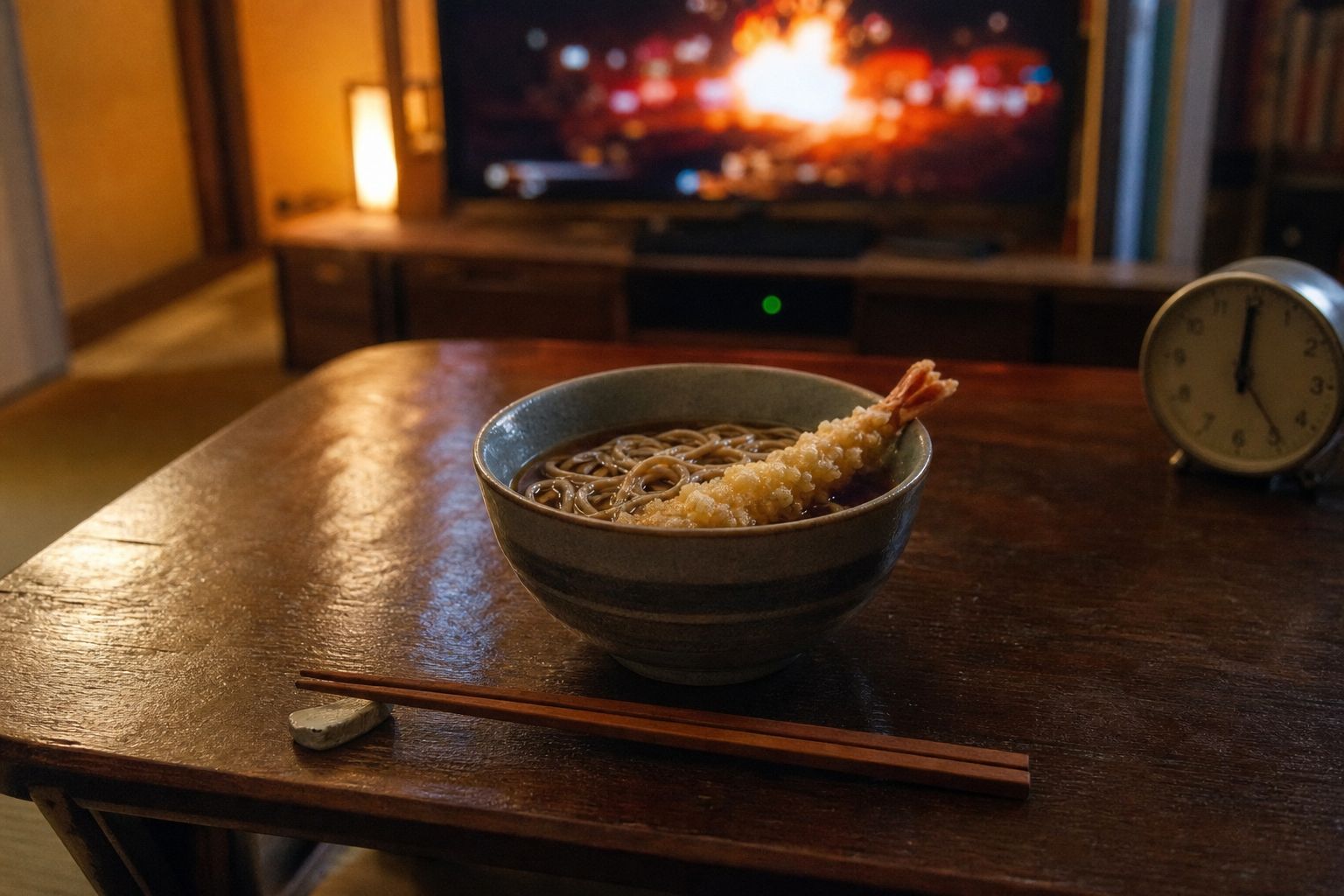
I’ll be upfront about something before I get into this one: I don’t have a specific memory of my own last bowl of toshikoshi soba to hand you. No store name, no year, no family argument about toppings. So treat this as a research piece, built from reporting rather than my own kitchen.
What I can tell you is the mechanics of the thing, because they’re genuinely stranger than “Japan eats noodles on New Year’s Eve” makes it sound.
The short version: on December 31st, most households in Japan eat a bowl of soba — thin buckwheat noodles — sometime between dinner and midnight. The point isn’t really the flavor. It’s a small ritual built around finishing before the year changes, tied to a handful of competing explanations for why noodles specifically, and it comes with at least two regional exceptions that break the “most households” part entirely.
Why soba, and why nobody fully agrees on the reason
The custom’s name, toshikoshi soba, translates literally to “year-crossing soba” — toshi (year) plus koshi (crossing). That part’s settled. The why is where it gets messier, because multiple origin stories have survived side by side for centuries and nobody’s picked a winner.
The most repeated explanation is about shape: long, thin noodles as a wish for a long, thin — meaning slender and lasting — life into the new year. A second version flips that same shape into a different metaphor: soba noodles snap easily, so eating them is a way of cutting yourself loose from the year’s bad luck and debts before they follow you into January. A third story, more niche, claims Edo-period goldsmiths used buckwheat dough to collect stray flecks of gold dust off their workbenches, which made soba an emblem of gathering fortune rather than losing it.
There’s also a timeline dispute. Some accounts trace the habit back to the Kamakura period, as early as the 13th century, pointing to a temple that reportedly handed out soba to struggling locals at year’s end. Most food historians land somewhere more specific and more recent: the custom became a widespread, documented practice among Edo-period merchants, with one of the oldest written references appearing in a book published in 1814. However old the root actually is, the version everyone does today — a quick bowl at home on the 31st — is the merchant-era version that stuck.
The part that actually has a deadline
Here’s what separates this from most “comfort food you eat around the holidays” traditions: toshikoshi soba is supposed to be finished, not just served, before the year ends.
In practice that means eating it sometime between the evening of the 31st and the hour or so before midnight — a window loose enough to fit around dinner, around NHK’s year-end Kōhaku Uta Gassen song contest (a broadcast that runs until roughly 11:45 p.m. and doubles as the unofficial soundtrack for a lot of households’ last meal of the year), or around whatever else is happening that night.
The actual rule people repeat is to be done eating before the joya no kane — the temple bells rung 108 times at midnight to mark the New Year — finish ringing. Carrying uneaten soba across that line is the thing you’re supposed to avoid. The logic loops back to the same two origin stories: if the noodles represent a long life or a clean break from the old year’s troubles, leaving some on the table past midnight undoes the wish. You’re not finishing a snack. You’re closing out an account before the books flip over to January.
It’s not one dish. It’s at least three.
Treat “Japan eats soba on New Year’s Eve” as a national default with real, acknowledged exceptions, not a universal rule everyone follows the same way.
| Where | What actually happens |
|---|---|
| Most of Japan | Soba, eaten evening-to-late-night on December 31st |
| Kagawa Prefecture | A real minority custom swaps in toshikoshi udon instead, playing on the same “long and thick into the new year” wordplay — though soba still reportedly wins out in most Kagawa households |
| Okinawa | The local “soba” people reach for is Okinawa soba, a wheat-flour noodle with no buckwheat in it at all, closer in texture to ramen or udon. Accounts differ on how old this habit actually is there versus soba |
| Aizu, Fukushima | Soba gets eaten on New Year’s Day instead of New Year’s Eve — same noodle, different date entirely |
| Parts of Niigata | Some households wait and eat it right at midnight rather than before it |
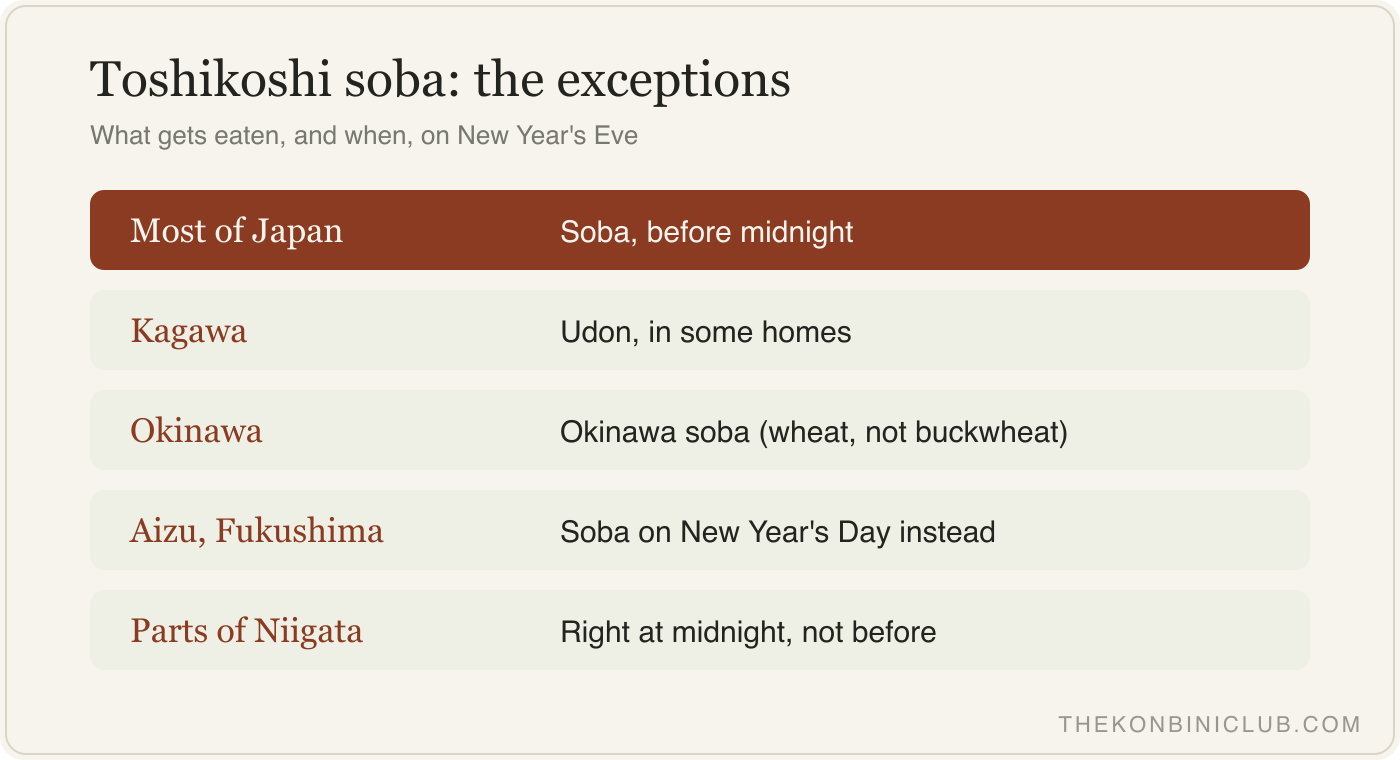
So when a guide (including, honestly, parts of this one) says “Japan eats soba on December 31st,” what it actually means is “most of Japan, on most years, with household-level variation nobody’s ever fully surveyed.” The Okinawa and Kagawa cases aren’t folklore footnotes — they’re the same custom’s logic applied to a different local noodle.
What actually goes on top, and the one I’d skip
The most common topping by a wide margin is ebi tempura — a shrimp fried whole, often with the tail left visible. The stated reason is the shrimp’s curled, bent shape, read as a stand-in for the hunched back of someone who’s lived a long life. A kakiage (a mixed vegetable-and-shrimp fritter) shows up almost as often as a cheaper substitute that still gets you the fried-topping texture.
In Hokkaido and parts of Kyoto, nishin soba swaps in simmered herring instead of tempura — a regional pairing old enough that it’s basically its own dish rather than a topping choice.
My honest opinion, which I know some readers will disagree with: skip the loaded “deluxe” trays that stack tempura, kamaboko (fish cake), naruto, and mitsuba leaf onto one bowl. It looks generous in the supermarket photo and turns into a textural mess by the third bite, with the broth doing the least amount of work on the actual plate. One good tempura and a simple broth beats four mediocre toppings fighting each other.
Where this actually gets bought, this time of year
Fresh, two-serving “nama-soba” packs start showing up in supermarket refrigerated sections in the final days of December, usually bundled with a small sachet of concentrated dashi so you’re not making broth from nothing. Budget supermarket chains push a genuinely cheap version of this — one discount chain has marketed a no-frills pack at under ¥200 per serving, noodles only, broth and toppings extra.
If cooking isn’t the point of your evening, sit-down soba and udon chains run their own preorder system that’s a smaller, lower-stakes cousin of how convenience stores handle Christmas cake reservations: order ahead online, pick up on the 30th or 31st, skip the kitchen entirely. One chain’s listing this year, for a dashi-included, two-serving fresh-noodle set for takeout, runs ¥990 — not fundamentally different in spirit from how oden shifted from a pot you serve yourself to a sealed cup you just pick up: less hands-on, more planned ahead, same underlying food.
What you won’t find much of is a dedicated “toshikoshi soba” instant cup version pushed hard at the register the way Christmas cake or oden gets promoted. This one lives in the fresh and dried-noodle aisle, well away from the hot case.
Getting the version that actually travels
Fresh soba doesn’t ship, but dried soba absolutely does, and it’s the one part of this custom that’s genuinely easy to recreate outside Japan. Look for a package that says Shinshu soba — a protected name tied to Nagano Prefecture, where the regional cooperative requires at least 40% buckwheat flour for a product to legally carry the label. Hakubaku is the brand most likely to actually be sitting on a shelf at a Japanese or Asian grocery store, or a quick search away online, and it’s a reasonable first buy if you’ve never cooked dried soba before. It won’t have the chewier, slightly stickier bite of a fresh pack from a Japanese supermarket case — dried noodles just land firmer — but it’s close enough for a dish you’re only making once a year.
Dashi concentrate, scallions, and a shrimp tempura you fry or buy frozen round out the rest, and all of that sits comfortably alongside the shelf-stable side of Japanese snacking if you’re building a New Year’s Eve spread from an import order rather than a local trip. If you’d rather have a curated box pick the seasonal items for you instead of sourcing each piece yourself, our Sakuraco, TokyoTreat, and Bokksu comparison is the place to check whether any of the three are running something year-end-specific that particular month.
I won’t pretend I have a strong opinion on which topping is “correct,” since I don’t have a bowl of my own to point to this year. What I will say is that the deadline is the actual point of the custom, more than the noodle itself — eat it whenever works for your evening, just don’t let it sit there after the bells stop ringing.
Omae wa mou… hamatteiru. (You’re already hooked. Nani?!)
— Sen
The Konbini Hit List (Free)
The everyday snacks people here actually buy — a printable tick-list with the Japanese name to search for when you order online.
Get the hit list →