Food Guides
Konbini Onigiri: Why Japan's 200-Yen Rice Ball Is Finally Getting Cheaper
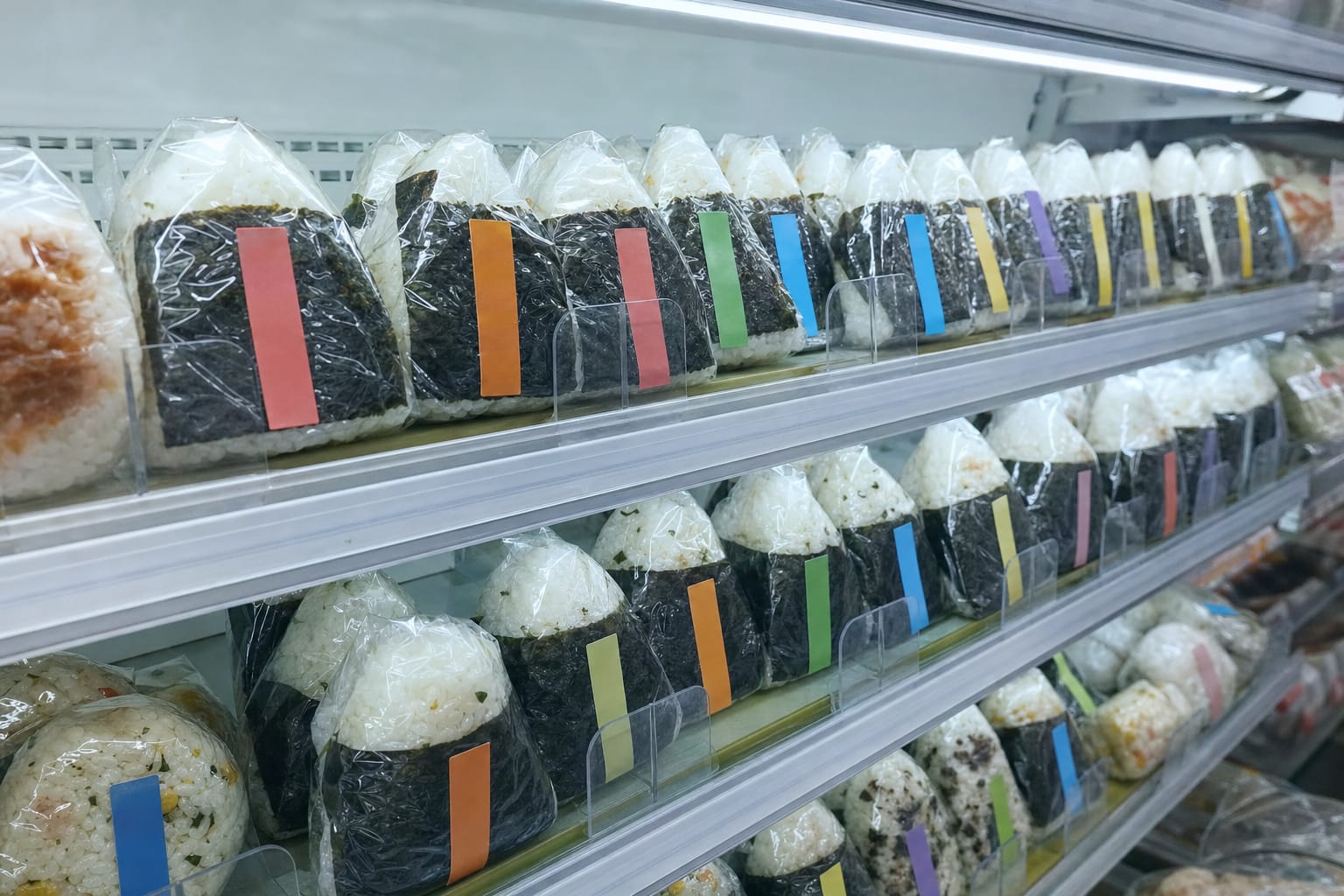
For most of the last two years, the reflex I’ve watched in other people at the onigiri shelf has been the same: pick one up, glance at the price tag, put it back, pick up a cheaper one instead. A plain tuna mayo rice ball that used to be an afterthought purchase — the thing you grabbed without doing math — started costing more than a bag of chips. That’s not a complaint about inflation in the abstract. It’s what happens when a country’s staple grain has a bad year.
The short version: Japan’s big three convenience store chains are cutting onigiri prices between late August and the end of September — the first cuts since the increases started, after last year’s rice shortage eased. Here’s what actually costs what right now, which fillings are worth your ¥170–230, and the wrapper trick that still catches people out.
Why your rice ball got expensive in the first place
Japan had a genuine rice shortage last year. Supply tightened enough that the government released stockpiled rice to cool prices, and every business built on rice — from lunch-set restaurants to the onigiri case at your local Lawson — absorbed the cost one way or another. Convenience stores mostly chose to raise prices rather than shrink the rice ball, and by early this year, the salmon and mentaiko rice balls at the big chains had drifted past ¥200 — ¥232 at 7-Eleven, ¥235 at Lawson — while even the plain fillings that once sat comfortably under ¥150 were creeping up toward that line. Industry writers started calling it, only half-jokingly, the “200-yen era.”
I felt this one directly. Lunch on a rushed weekday used to mean two onigiri and a bottle of tea from the register fridge, total under ¥400. Somewhere around this spring that same combo started running closer to ¥550, and I noticed the change the way you notice a subway fare hike — not devastating, just constantly, mildly annoying.
The cuts landing right now
Rice supply has eased since, and over the past few weeks all three chains have announced reductions on at least part of their onigiri lineup — not a full rollback to pre-shortage prices, but the first move in that direction since this started.
| Chain | Item | Old price | New price | Effective |
|---|---|---|---|---|
| 7-Eleven | Salmon / mentaiko (spicy cod roe) | ¥232 | ¥213 | Sept. 8, 2026 |
| Lawson | Sea chicken mayo | ¥181 | ¥171 | Sept. 29, 2026 |
| Lawson | Ume / kombu / okaka | ¥194 | ¥184 | Sept. 29, 2026 |
| Lawson | Grilled salmon | ¥221 | ¥211 | Sept. 29, 2026 |
| Lawson | Mentaiko | ¥235 | ¥225 | Sept. 29, 2026 |
| FamilyMart | Kombu & tuna mayo Big Musubi | ¥320 | ¥298 | Aug. 24, 2026 |
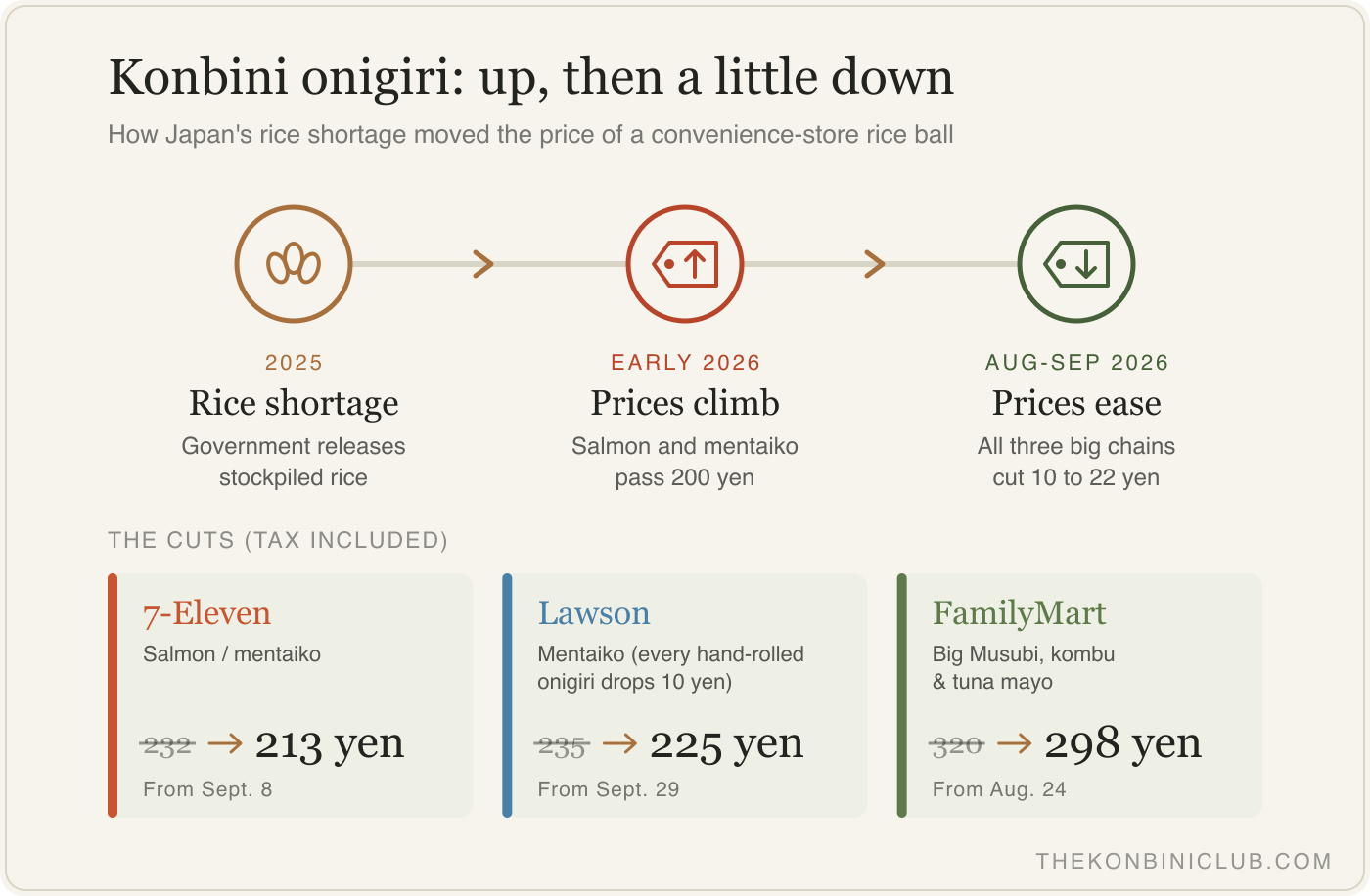
None of this brings anything back to the sub-¥150 shelf I remember from a few years ago. It’s a ¥10–22 correction on a rice ball that climbed well past that during the shortage, which tells you roughly where rice costs still sit compared to before — better, not solved.
What to actually order
Tuna mayo is the default for a reason: mild, filling, and the one flavor every chain sells a version of, which makes it the safest first buy if you’ve never had one. Salmon is the other genuinely universal pick — salted, flaked, savory rather than sweet, and the one I’d hand a first-timer if tuna mayo felt too plain.
Mentaiko (spicy, marinated cod roe) is where opinions split hard, and I’ll put mine on the record: I like it, but it’s not a beginner filling. The texture is closer to a briny paste than anything flake-shaped, and the “spicy” label undersells how much this is a fish flavor first, heat second. If you’re trying one for the first time, don’t start here.
The one I’d actually skip, price cut or not, is the extra-rich “mentaiko mayo” double filling some chains run as a limited flavor. It layers spicy cod roe with mayonnaise on top of already-salty rice, and the result reads bimyou to me — a Japanese word for “so-so,” not bad exactly, just not quite landing, the kind of verdict that’s harder to translate than “good” or “bad” because it genuinely could go either way depending who’s eating it. Two strong flavors compete instead of combining, and I’d rather order them separately.
Plain kombu (simmered kelp) and umeboshi (pickled plum) are the ones locals tend to grab out of habit more than excitement — they’re fine, they’re cheap, and they’re the fillings you build a taste for over years rather than fall for immediately.
One thing worth knowing before you judge a whole chain off one rice ball: every konbini is uneven shelf by shelf. Lawson is the chain I’d pick for sweets — the matcha desserts especially, and the freezer case I’ve written about before holds up too — but that reputation doesn’t automatically carry over to the onigiri rack a few steps away. Trusting one section of a store because of another isn’t rational, exactly, but it’s how most people actually shop, myself included.
The wrapper trick nobody explains
If you’ve torn the seaweed halfway through unwrapping an onigiri, you’re not clumsy — the plastic film is doing something specific and it’s easy to rush.
Convenience store onigiri use a three-layer wrap: a strip of plastic sits between the rice and the seaweed, keeping the nori crisp instead of going soft and chewy from rice moisture, which is exactly what happens to a homemade one left in a bag for an hour. 7-Eleven started selling rice balls wrapped this way in 1978, and the basic idea has barely changed since — that’s genuinely rare for anything in a fast-moving retail category.
- Pull tab ① — the strip at the top point — straight down across the front of the rice ball, all the way to the bottom. This splits the outer film down the middle.
- Pull the left half (②) off sideways, gently, so the seaweed slides out of the film instead of coming with it.
- Pull the right half (③) off the same way, and the nori settles around the rice as the last of the wrap comes free.
The failure mode is almost always rushing steps two and three — yank the halves off too fast and the corners of the nori stay trapped in the film, so you’re left with a rice ball wearing a torn half-sheet of seaweed. I still mess this up occasionally when I’m eating one-handed on the train, seaweed shreds and all, so don’t feel bad if attempt one goes sideways.
A rice ball with its own charity campaign
Here’s a detail most people outside Japan have never heard: onigiri has an actual annual charity event named after it. Every autumn, a nonprofit called TABLE FOR TWO runs “Onigiri Action” — post a photo of any onigiri, anywhere, with the campaign hashtag, and partner sponsors donate toward school meals for children in East Africa and Southeast Asia. Recent years have run from early October into mid-November, and past campaigns have logged well over a million donated meals from a few hundred thousand photos. It’s a low-effort way to turn a lunch you were already eating into something that helps somebody else, and I mention it here because almost nobody outside Japan seems to know it exists.
Getting the experience if you’re not in Japan
A fresh, still-crisp konbini onigiri genuinely doesn’t ship — it’s a same-day food, full stop, in the same category as the tamago sando two shelves over. What does ship well is the shelf-stable version of this experience: furikake and rice seasoning packets, nori sheets, umeboshi in a jar, and the pre-formed onigiri molds that let you build your own at home in about the shape and size of the real thing. Our Japanese snack starter list covers where to source those piece by piece, and if you’d rather have someone else curate the box, our honest comparison of Sakuraco, TokyoTreat, and Bokksu is the place to start.
Prices are still higher than they were three years ago, and I doubt anyone at these chains is promising they’ll stay down. But for the first time since this started, the number on the tag is moving in the direction shoppers actually want, and that’s worth noticing even if it’s only a few yen at a time.
— Sen
The Konbini Hit List (Free)
The 25 snacks Japanese people actually buy — printable, with what to order online when you can't fly to Tokyo.
Get the hit list →